1. Introduction - Distance to the Moon
The universe is enormous. Not just big. Not just “that looks like a long drive” big. Properly, absurdly, mind-stretchingly enormous.
Fair enough.
As far as we know,
we are the most complex and inventive beings we know of:
minds that can measure it,
draw it,
argue about it,
fly through it,
and build really cool games to help understand it.
And if you have read this far,
you are choosing to do more than just play the game.
You are choosing to understand the real complexities within the game.
I respect that.
Curiosity like that can take your mind to places most people never seriously explore.
That is not ordinary, in the best possible way.
That is astonishing, and it really is worth celebrating!
Us humans are not naturally good with these very large numbers. I can say that the Moon is about 384,400 kilometres away, but the number is so large that we can't really picture it. It is just another factoid, not a digestible experience. If you prefer imperial measurements, I could say 238,855 miles, a smaller number, but no more digestible. This page makes those distances feel a little more human. I take the real measurements behind the Moon Lander game settings and put them into a better digestible perspective using some human scaled representations to make them more human-readable.
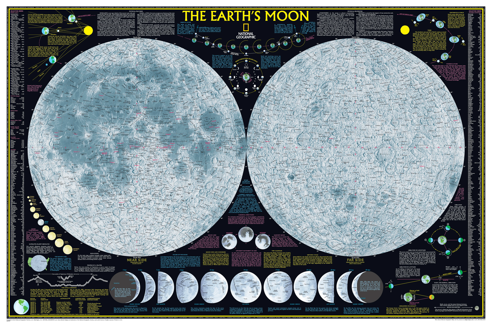
The Moon Map on the Classroom Wall
I first saw this information well presented on the National Geographic Moon wall map. The map is large (108x72.4 cm / 42.5x28.5 inches), in the 1970's, it was on the wall in so many classrooms.
At the base of the map was a diagram, with the Earth on the left hand side, and the moon on the right hand side, with two trace lines between them, showing outwards and return journeys for Apollo 11. The Earth and the moon were small and drawn to scale, and the distance was also drawn to scale, so that you could see how far away it really is.
That diagram made the point in a way that words could not. The Moon is not just “up there”. It is a long way away. It is a very long way away.
2. Key Measurements
Executive summary
There is a lot of information on this page.
So, let's just cut to the chase...
This page will tell you that the distance to the moon is about
110 times the distance of a long cross-country trip on Earth
(Los Angeles to Kennedy Space Center, or London to Cairo).
The other interesting thing about that long cross-country trip
is that it is effectively the same distance as the diameter of the moon itself.
That distance between the Earth and the Moon is an average... Because the Moon's orbit is elliptical (slightly egg shaped), the distance changes, ranging from about 363,500 to 405,500 km. Or we could just say 384,400 kilometres plus or minus 5%.
How Big Is the Moon?
You will regularly see comparison images like these:
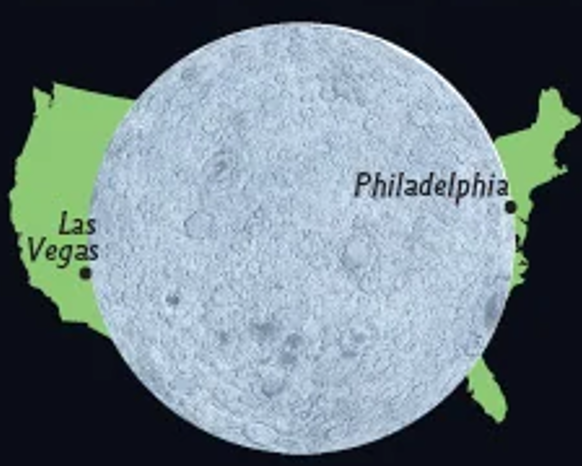
Image credit: National Geographic
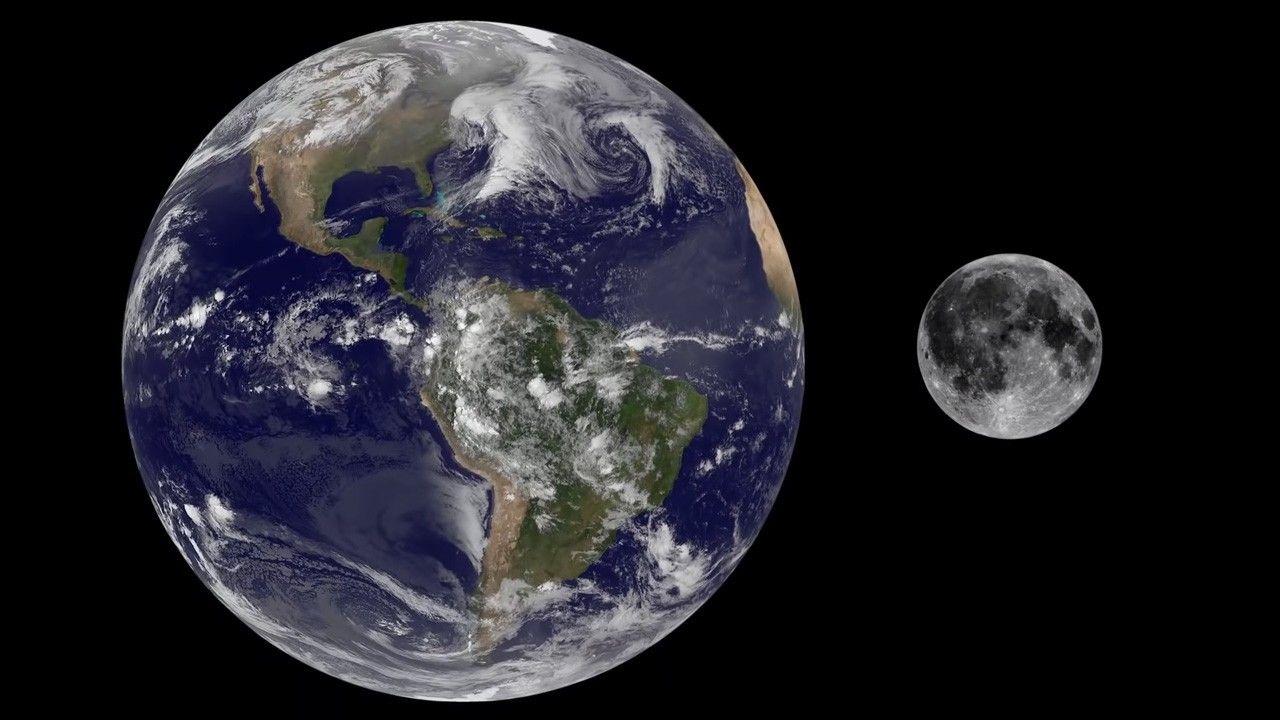
Image credit: NASA/JPL-Caltech
These images are useful because they show that the Moon is about one quarter the width of Earth. But they can also be deceptive, because they do not show the large empty distance between Earth and the Moon.
Moon-Sized Trips on Earth
Let's get a better perspective on size. We have already said that the moon is 3,475 kilometres wide. This is the smallest of the big numbers I want to be able to help you to get a perspective of. So it should be the simplest to understand. Let's compare that distance with something we already know, some distances we can understand, these are straight-line (Great Circle) distances between some well known cities / locations here on Earth that are similar distances to compare with the width of the Moon:
- Asia: Singapore to Kathmandu Nepal - About 3,531 km
- Australia: Sydney NSW to Perth WA - About 3,290 km
- Europe / Africa: London UK to Cairo Egypt - About 3,511 km
- North America: Los Angeles CA to Kennedy Space Center FL - About 3,600 km
- South America: Northern most Chile to Southern most Chile - About 4,051 km
- South Pacific: Christchurch NZ to McMurdo Station Antarctica - About 3,825 km
If you were to fly one of these distances on Earth, in a typical modern passenger jet cruising at around 850 kilometres per hour, it will cover one of those large cross-country distances in about 4 hours. At that simple cruise speed, ignoring all the practical complications.
Or, you could walk, at walking pace (4 km/h), the distance becomes almost absurd: about 850 to 900 hours of walking, or around 80 days if you walked 12 hours per day (this is ignoring many other practical complications, like crossing the sea, rivers and mountains).
These long distance trips help us to tell a story. They are all crossing a large expanse of land and/or sea, these are significant long trips that most of us would only consider in the comfort of a modern jet.
McMurdo Station and a Future Lunar Base
This is a bit of a Greg tangent here... That last distance I showed is an interesting one for a few reasons... It is over some of the most remote parts of our planet (and I grew up not far from the New Zealand end).
McMurdo Station is not just far away, at the south pole. It is remote, harsh, cold, expensive to reach, and dependent on well planned careful logistics. People who winter over in Antarctica live in a place where the outside environment is dangerous, supplies matter, machinery matters, power matters, communication matters, and small mistakes can become serious (fatal) very quickly.
That gives us a useful Earth-based comparison for thinking about a future lunar base. A lunar base would be even more extreme than Antarctica. It would have no breathable atmosphere, much lower gravity, harsher radiation, greater isolation, and a much longer supply chain.
But the basic human challenges are similar. How do people live and work in a place where the environment does not forgive mistakes? It is interesting to note that Christina Koch (Artemis II astronaut) spent significant time in Antarctica. This could be a great training ground to learn and verify the right stuff for people going to a lunar base.
How Big Is the Earth?
We have already said that the earth is 12,742 kilometres wide. This is easy to imagine, just look out the window, look down, the earth is the size of that large pile of dirt you are standing on.
There is a little bit more to it than that. We have just talked about the how large the moon is, comparing the size (diameter) of the moon to a large cross-country trip. When we are looking at distances on earth, we measure distances on the surface (while the shortest distance is a straight line, it very quickly becomes very hard to go in straight line because that large pile of dirt gets in the way).
Let's look at that large cross-country trip in a little more detail, for now, we will focus on just one of the examples: from Los Angeles CA to Kennedy Space Center FL, a distance of 3,600 km
Earth Surface Distance and Straight-Line Depth
If we take a surface span of 3,600 km on a spherical Earth, the straight line between the two end points does not stay near the surface. It cuts through the Earth, and at the halfway point it is about 252 km below the surface. This is simpler to see on the full circle of the earth:
For a spherical Earth with diameter 12,742 kilometres, a surface span of 3,600 kilometres corresponds to a central angle of 32.4°. The straight-line chord between the two surface points is 3,552 kilometres, and at the halfway point it passes 252.6 kilometres below the surface.
This angular distance of 32.4 degrees, divides into 180, half way around the Earth, 5.5 times. So if we want to fly to the opposite side of the Earth, it is going to take 4 hours times 5.5 = 22 and a half hours. (which feels about right after my last London trip).
Let's draw that depth line on the diagram....
Real Earth to Moon Distance
Could all the Planets Fit Between Earth and the Moon?
There are some fun images out there that show the Earth and the Moon to scale, where the distance between the earth and the moon can (erroneously) fit all planets in between.
Planet imagery in this scale montage is sourced from multiple NASA mission image archives from NASA Science. This version of this montage is my work, from ideas from multiple sources.
Reality check...
- This is just a fun drawing...
- There is ALMOST enough space between the Earth and the Moon to fit all the other planets in between (if you go from centre to centre of the Earth / Moon system, there is enough space).
- This maybe starts to help a bit to get a feeling for the size, but the reality is most of us do not really have a good idea of the size of all the planets either.
- It would be a very catastrophic day on Earth if all the planets were to settle into that space (just think what it would do to the tides).
- This only works if we ignore the size of Saturn's rings (they more than double the size of the planet if we include them, in this image, I had to bump Saturn down the page to make space to show it).
About 110 Long Earth Trips between the Earth and the Moon
There are some interesting things to notice about these distances:
- Our typical Long Earth Trip (3,635), is just larger than the diameter of the Moon (3,475 kilometres).
- For a simple comparison, let’s treat our long Earth trip as roughly the same distance as the Moon’s width.
- If we divide the distance to the Moon (384,400 kilometres) by the width of the Moon (3,475 kilometres), the resulting number is the number times the Moon could fit between the Earth and the Moon (110.63).
- We could just round that number off, and say that the distance to the Moon is about 110 times the width of the Moon.
- As our typical Long Earth Trip is a similar distance to the width of the Moon, we could also say that the Moon is about 110 times the length of our typical Long Earth Trip away.
Or in our passenger jet, at a speed of about 850 km/h, the flight time would 440 hours (or 18 days, 8 hours) each way. This also ignores more practical complications (like that jets stop working outside the atmosphere, you would need to refuel several times on the way, and most importantly, the jet would slow down from fighting gravity almost all of the way to the Moon).
If we Could scale down the world
The idea is simple: if Earth were the size of a Soccer ball, how big would everything else be?
The table below shows each real measurement, then the equivalent size at the current scale. This is where the scale starts to become easier to picture.
| Measurement | Real metric | Real imperial | Scaled metric | Scaled imperial | Notes |
|---|---|---|---|---|---|
| Earth diameter | 12,742 km | 7,917.51 miles | 22.00 cm | 8.661 in | Our reference size |
| Earth circumference | 40,023 km | 24,868.90 miles | 69.10 cm | 27.206 in | Distance around Earth at the equator |
| Moon diameter | 3,475 km | 2,159.14 miles | 6.00 cm | 2.362 in | Size of the Moon |
| Average Earth-to-Moon distance | 384,400 km | 238,855.09 miles | 6.64 m | 21.77 ft | Average centre-to-centre distance |
| Mount Everest height | 8.85 km | 5.50 miles | 0.153 mm | 0.006 in | Highest mountain above sea level |
| Typical passenger plane cruise altitude | 11.00 km | 6.84 miles | 0.190 mm | 0.007 in | Representative cruising altitude for a commercial passenger jet |
| Troposphere height | 12.00 km | 7.46 miles | 0.207 mm | 0.008 in | Lowest major atmospheric layer, where most weather happens |
| Kármán line | 100.00 km | 62.14 miles | 1.73 mm | 0.068 in | Common practical reference for the edge of space |
| International Space Station altitude | 408.00 km | 253.52 miles | 7.04 mm | 0.277 in | Approximate orbital altitude |
| Geostationary orbit altitude | 35,786 km | 22,236.39 miles | 61.79 cm | 24.326 in | Altitude of geostationary orbit |
Earth Surface and Atmosphere
One of the surprising things about Earth is how thin the atmosphere is compared with the size of the planet. A passenger aircraft may feel very high when we are sitting in it, but compared with Earth it is still very close to the surface.
Earth's atmosphere has no exact hard upper edge. This page uses the Kármán line as a practical reference point for where space begins. The atmosphere is exaggerated in this diagram because, at true scale, it would be only a very thin skin around Earth.
This diagram is intended to show the relative thinness of the atmosphere. The vertical scale is exaggerated so the layers can be seen clearly. I will add a another diagram, with the correct scale, where you will hardly see the atmosphere.